
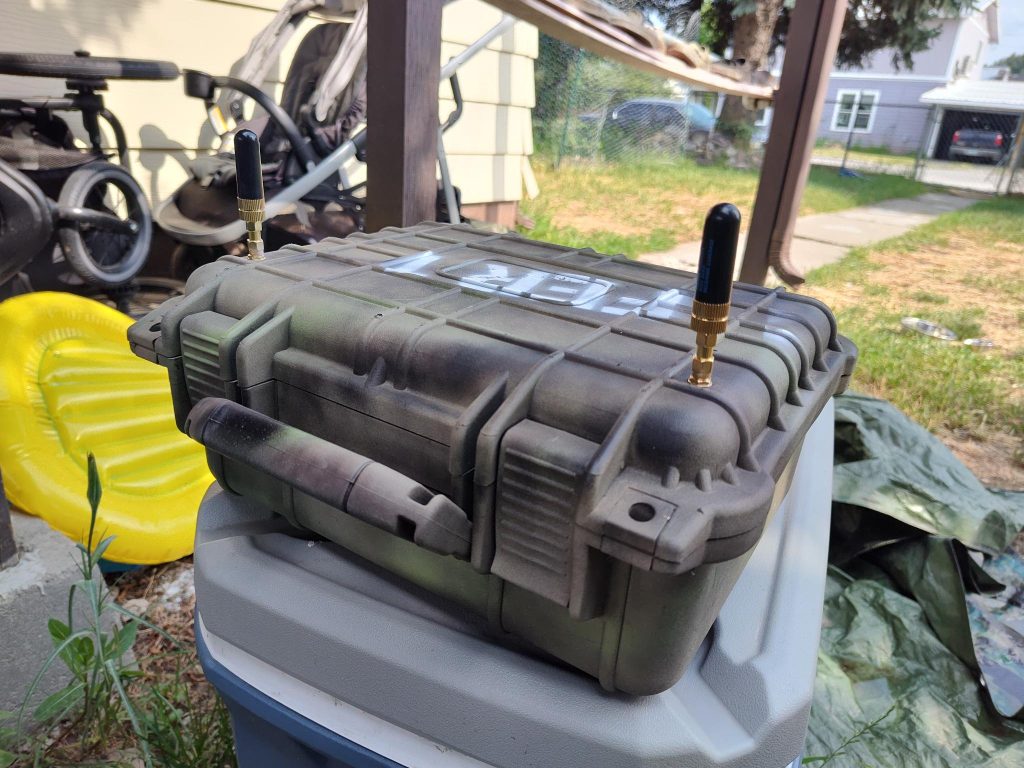
With the limited range of handheld and mobile radios, they can be difficult to use in specific areas/scenarios. Challenging terrain and long distances between operators can cause communication to become spotty, or impossible. A simple solution to mitigate these problems is a radio repeater.
A radio repeater receives a signal on one frequency, and re-transmits it on another close by frequency (offset). They can increase range significantly, and if placed in a strategic location, allow radio signals to traverse terrain they normally would be unable to.
Most repeaters you have heard of used by HAM radio operators are usually permanently installed on top of a mountain or a central location with the antenna(s) high up on a tall tower for maximum performance. These setups are great for what they are used for, but cost thousands of dollars and require a lot of technical knowledge to set up and maintain.
That is where the Field Expedient Repeater (the FER) comes in. Built with two cheap handheld radios, the FER can be assembled in about an hour for about $100 at the time of writing. This mobile repeater can be placed in a strategic location to expand the range of any handheld or mobile radio you are using.
Use Cases
Imagine you are out in the field in a mountainous area, and you need radio communication from one side of a mountian to the other. Normally, vhf and uhf signals would not be able to make it over the mountain, but placing a FER on a ridge or at the peak of the mountain will join the two sides. This is because each operator will be connecting directly to the FER instead of each other. The FER then takes whatever signal it recieves, and rebroacasts it from its location.
Parts List:
These are all the parts you need to assemble your own FER. The Amazon links provided are affiliate links and we get a small commission if you purchase these items with our links.


Build
1. Start by drilling two holes in opposite corners of the waterproof case big enough for the SMA bulkhead connectors to fit through, and bolt down the SMA bulkhead connectors to these holes.


2. Connect the other end of the SMA cables to the two radios. Use gender changers as needed.

3. Decide which radio with be the receiving (rx) radio, and which will be the transmitting (tx) radio, and program them accordingly. For example, if we were using the FER as a GMRS repeater on GMRS repeater channel 15 (467.5500 MHZ), we would use a +5 MHZ offset. This means the rx radio needs to be programmed to 467.5500 MHZ, and the tx radio needs to be programmed to 462.5500 MHZ. Additionally, you could add DCS or CTCSS codes for added filtering, but this is optional.
4. Plug the repeater box into both radios ensuring the receive side of the box is plugged into the rx radio, and the transmit side of the box is plugged into the tx radio (some repeater boxes don’t have rx and tx sides, and will work however you plug them in).

5. Attach an antenna to each bulkhead connector on the outside of the waterproof container.

6. Program your radios you intend to use with the repeater accordingly. In our example, you would program your radios to receive at 462.5500 MHZ, and transmit at a +5 MHZ offset (467.5500 MHZ).
A couple notes: If you intend on painting your FER like we did, it is best to paint it before drilling the holes, and assembling the FER. This allows you to paint without taping anything off. Also, when programming the radios you will use with the FER, it is best to save the configuration with the name “FER” or something similar for ease of use. Finally, it is best to label each radio “TX” and “RX” respectively so you don’t get them mixed up while assembling.
Operation
To use the FER, attach an antenna to each bulkhead connector on the outside of the unit. In our testing, we had lots of interference using two Baofeng “rubber ducky” antennas, but had good luck with other antennas. Open the case and turn both radios on and up to full volume. Tune to the FER channel you programmed into your other radios and do a radio check. If everything is put together correctly, and programmed correctly, you will be able to communicate without any problems between all your radios. It is recommended that you put a lock on your FER, and chain it to something where you leave it (like a tree) to prevent theft or tampering.
Troubleshooting
If you are hearing lots of interference when using the FER (ie, garbled signal, alraming, repeating noises, etc.), try different antennas. Using different length antennas (one short, one long) might help as well.
If you hear silence when trying to use the FER, ensure both radios in the FER are on, and both cables from the repeater box are seated in the radios fully. If the radios are on, and the cables are fully seated, double check your programming.
How to make a FER in the Field in a Pinch
What happens if you don’t have time to build the FER explained above? What if you are in need of a repeater right now, and you are already out in the field?! The same thing can be accomplished with two handheld radios and some electrical/duct tape.
You will need to program one radio to be the receive radio and the other to be a transmit radio as before. The one difference you need to make is turning on VOX on the tx radio. This will auto key the radio whenever it picks up sound on it’s mic. You will need to program your other radios with an offset like before.
Place the rx and tx radios face to face, and tape them together. Turn both radios on, and it should now act as a repeater like the FER described above.
This method can be used in a pinch, but has some major drawbacks. Firstly, without the repeater box, the transmit radio will be broadcasting any transmissions it receives out loud. Anyone within ear shot of the repeater will be able to hear it. Secondly, the tx radio will key and transmit any sound it hears that is loud enough to trip the VOX. For example, if someone walked up to the repeater and said “What is this?” it would be transmitted to all the radios using the repeater. Thirdly, without the use of the repeater box, the sound quality will most likely not be as good. And finally, without the waterproof case, your radios may be damaged depending on the weather, reducing the reliability of the repeater.
Improving the FER
There are many improvements that can be made to the design discussed above. Some ideas we have are to add a larger battery, and a solar panel for longer run times. Another thing we have already done is to program the tx and rx radios with all our normally used channels so they can also be used as backup radios in case we have a radio fail or need to equip another person out in the field. Another great improvement would be adding a du plexer. This would allow the FER to only need one antenna instead of two, making it more reliable, and lessening the chance of interference.


Founder of Minuteman Theory